- Home
- The Embassy
- Consular Services
- Message for OCI cardholders
- Visa Services
- Passport Services
- OCI in lieu of PIO Card
- Surrender Certificate
- Miscellaneous Services
- Fee Schedule of Consular Services

- Emergency Cases & Contacts
- Various Application Forms
- Registration of Indian Nationals
- NRI Corner
- Frequently Asked Questions
- Renunciation of Indian Citizenship

- Indian Community Welfare Fund (ICWF)
- OCI SERVICES
- India - Madagascar
- India-Comoros
- Media
- Contact
- Scholarship
- Links
- GI Digital Catalogue
- ICAO
- IDF-OI
- India Investment Projects
- Initiatives in the area of education
- Department of Official Language
- Important Links of India
- Important links of Madagascar
- Indian Missions Abroad
- Indian Facts & Figures
- ICCR Scholarships
- India Perspectives Online
- Indian Diplomacy
- Indian Tourism
- India at a Glance
- Invest India
- GI Digital Catalogue
- Trade & Investment
- Emergency Consular Number (24x7)
for Indian Citizen only : 0333180001 - Skip to main content
- Screen Reader Access
-
Trade & Investment
Investment Opportunities in Madgascar
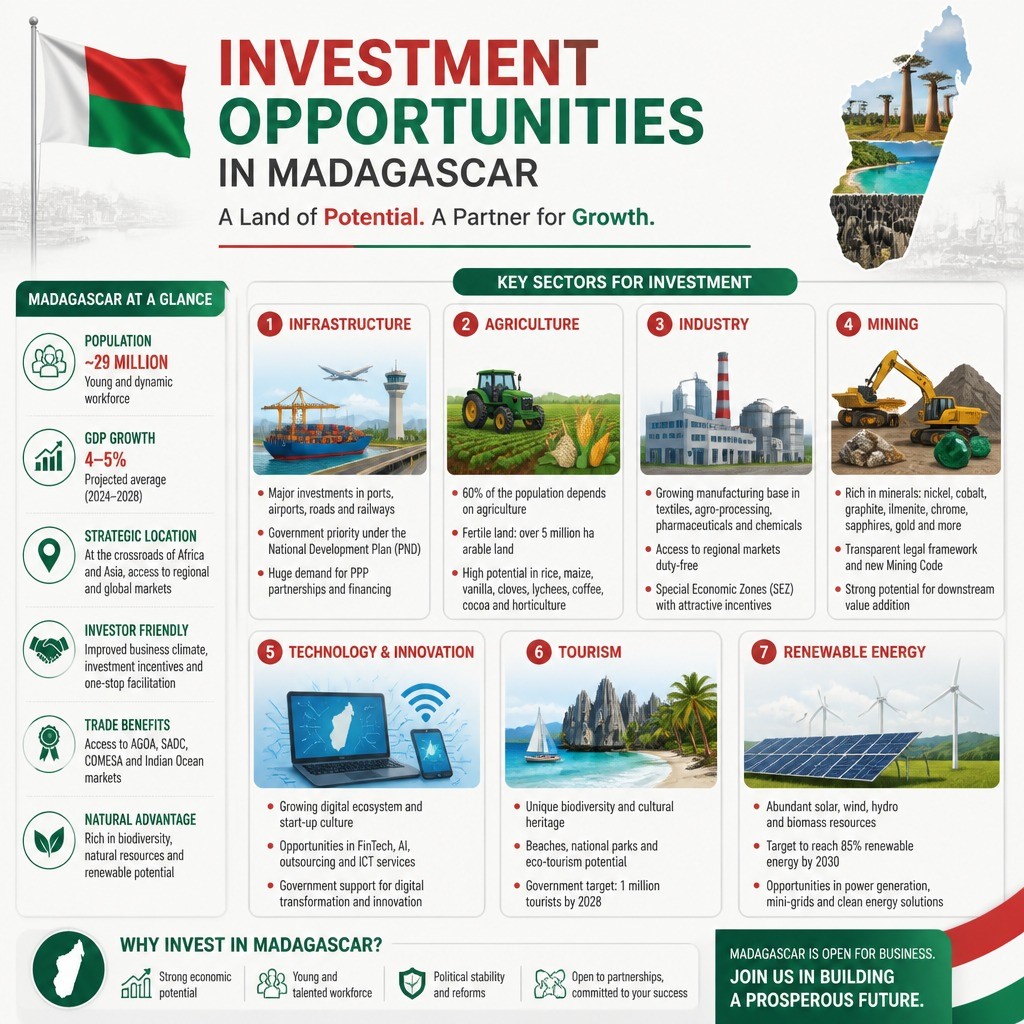
Madagascar offers diverse investment opportunities across infrastructure, agriculture, industry, mining, technology, tourism, and renewable energy, supported by new laws, PPP schemes, and a one-stop investment facilitation service.
Infrastructure
The country’s ports and airports are expanding, with Toamasina poised to become a maritime hub for the Indian Ocean, and Ivato and Nosy Be airports connecting Madagascar to major international airlines. Railways and national roads further strengthen logistics, especially for mining exports.
Agriculture
Agriculture remains a cornerstone of Madagascar’s economy, with 220,000 hectares of Agricultural Development Zones (ADA) allocated across regions for crops like rice, corn, cassava, groundnuts, vanilla, and livestock. Priority crops include rice and corn, both facing significant national deficits, as well as soybean, sorghum, groundnut, and viticulture. The government is also promoting 110,000 hectares of organic agriculture under PPP schemes, alongside fertilizer plants and greenhouse centers to boost productivity. Additionally, 68,945 hectares of private land are available for diverse crops, spices, essential oils, and aquaculture, offering investors a wide range of opportunities.
With its climate conducive to growing a wide variety of agricultural products, Madagascar offers fertile ground for investment in the agribusiness sector. Crops such as vanilla, cocoa, coffee, spices, and exotic fruits are in high demand on international markets. Investors can get involved in the production, processing, and export of these high-quality products.
Industry
Industry contributes 14% to Madagascar’s GDP, with over 600 new enterprises established between 2016 and 2022. The flagship program One District One Factory (ODOF) aims to set up 245 agro-processing units across all districts, requiring an estimated 49 million USD. Large-scale projects include industrial parks (765 million USD investment) and special economic zones in Diana, Toliara, Anosy, and Alaotra Mangoro, expected to generate tens of thousands of jobs. These initiatives are designed to attract foreign direct investment and expand the industrial base.
Mining
Madagascar is rich in mineral resources, including rare earths, iron, gold, coal, uranium, ilmenite, copper, and graphite. Current projects include Base Toliara (700 million USD, ilmenite), ERG (160 million USD, graphite), PAM Sakoa Coal (500 million USD), and Black Earth (100 million USD, coal and graphite). Several deposits, such as Ampasindava rare earths, Soalala iron, and Manantenina bauxite, await exploitation permits. Gold also presents strong potential, with four districts identified and more than 10 tons exported between 2016 and 2019. With its Mining code available in English, the Mining sector and regulateion of Madagascar is more transparent for the investors.
Technology & Innovation
Madagascar boasts strong internet infrastructure supported by submarine cables like LION, EASSY, METISS, and 2Africa. National coverage rates are high, with 3G reaching nearly all rural areas and 4G widely available in urban centers. Public projects focus on digital inclusion, modernization of administration, and reforms in civil status and identity systems. Investment opportunities include mobile app and software development, business process outsourcing, data digitalization, and call centers, leveraging the country’s bilingual and competitive workforce.
Tourism
Tourism is rebounding strongly, with visitor numbers approaching pre-pandemic levels. Projections estimate 760,000 tourists by 2026 and 1 million by 2028. Opportunities exist in hotel development, eco-tourism, cultural tourism, and conference facilities. Madagascar’s unique biodiversity, with over 80% of species endemic, positions the country as a premium destination for nature-based tourism and e creation of businesses offering eco-friendly activities, adventure tours, and travel services.
Renewable Energy
Madagascar is advancing renewable energy projects under a liberalized electricity framework. Opportunities lie in solar, hydro, wind, and biomass energy, with emphasis on self-production and PPP schemes. The government’s climate-conscious policies and energy reforms create a favorable environment for investors seeking sustainable ventures. On 24 April 2026, The Prime Minister office announced that the state is encouraging private operators of solar projects, particularly young entrepreneurs, with structural and administrative facilitation, while international institutions like the World Bank and IMF are backing these initiatives